For those born after the 2000s, it is difficult, if not impossible, to fathom a life without computers, smartphones, or the internet. These technologies have revolutionized our lives in innumerable ways, largely for the better: an intrepid inventor in an Indian village now has access to the same variety of knowledge as a banker on Wall Street, a true indicator of the world becoming a global village. However, the rising pervasiveness of these technologies has also increased our reliance on them — most could never imagine going a week without their smartphones. Recent innovations, such as the Neuralink, as well as the emergence of increasingly functional prostheses and bionics, have generated concerns about Transhumanism and its greater effect on the current trajectory of ‘human-robot blending’. In the wake of an ever-changing digital reality, as we learn more about our ethical relationships with our creations, how much of our own humanity are we willing to abandon chasing a technologically enhanced existence?
This speculative fiction story follows the journey of Adam, a police officer living in a somewhat distant future where human augmentation has become the norm in the dystopian society he lives in. Being a purely unaugmented person with a desire for a simpler, non-technological life puts him in direct conflict with most of the criminals he has been tasked with apprehending. This predicament is further complicated when, in a tussle with radical groups advocating for the preservation of human purity, he becomes the target of a brutal attack that leaves him mortally wounded, necessitating the inclusion of the very augmentations he disdained. Faced with no choice but to forfeit his ‘humanity’, Adam is forced to confront unsettling truths about the ethics of cybernetic enhancements and the evolving nature of discourse around the human body.
Thanks to Luke Sanneman, Shilpa Thakur, and Sreejani Chatterjee for working with me on this project!
How Thin is the Thin Blue Line?
Year 21XX, Mega City 43
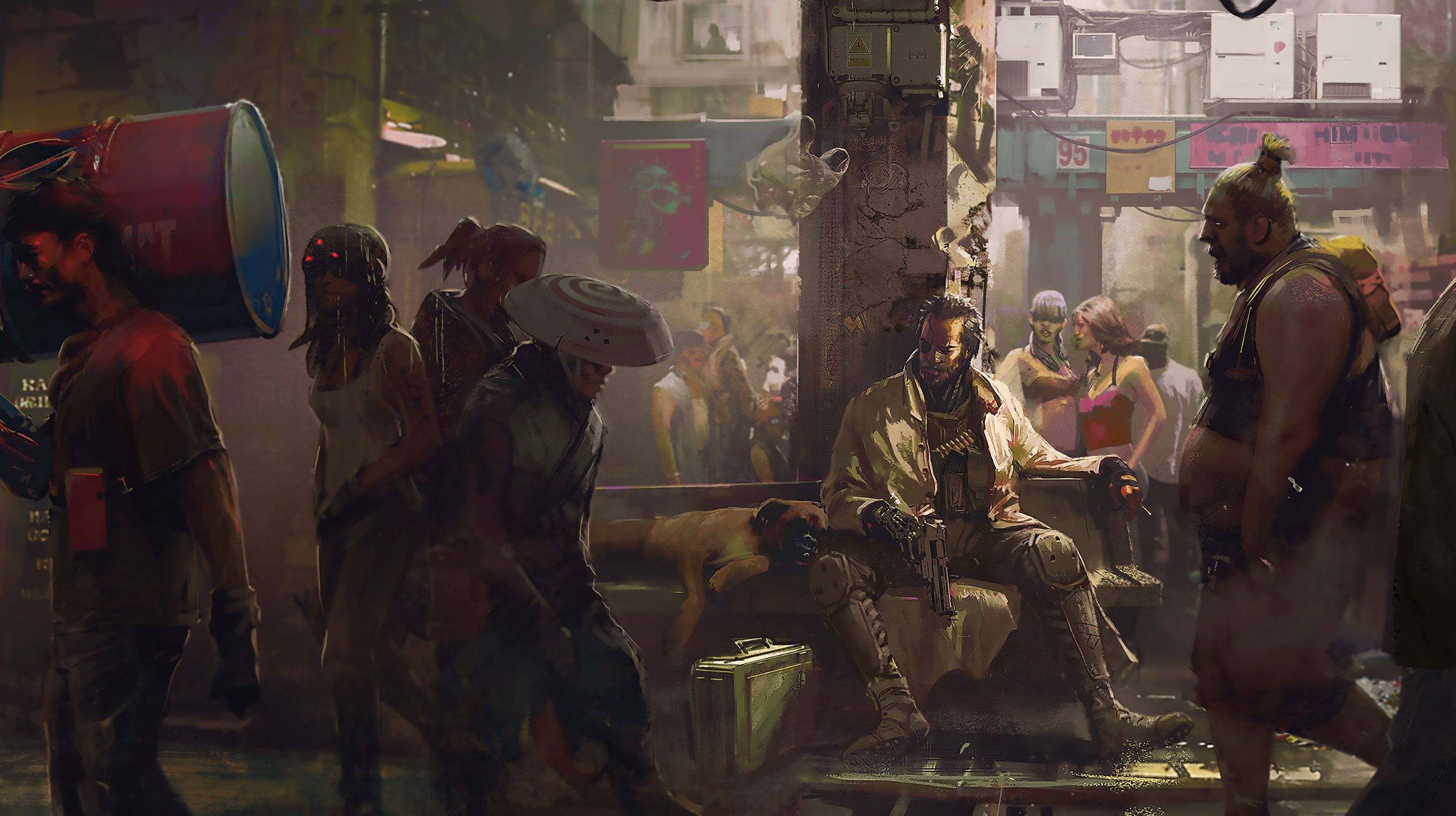
The precinct bustled as various electronic devices beeped and whirred — a symphony of the mundane that underscored Adam’s daily existence. As a trooper with the Department for the Investigation of Augmented Crimes (or DIAC), Adam’s primary duty was to investigate crimes involving ‘auggies’: humans outfitted with cybernetic augmentations who inhabited most of the precinct’s holding cells. With the evolution of human-integrated technology, people could choose to ‘upgrade’ themselves to acquire all manner of fanciful abilities, such as mind-linking, night vision or increased strength to punch through walls. One can imagine how well the underworld warmed up to these augments.
Adam huddled over his workstation. Representative illustration generated with AI.
Adam’s workstation was a testament to his aversion to augmentation. Hailing from the outer rings, where people lived the analog life — mostly out of necessity owing to dire financial straits but also subtle nostalgia for a past when human touch was prized over the cold precision of machinery — he appreciated seeing the pile of case folders beside his holographic computing interface, a reminder of simpler times and ways. However, as the only ‘blobbie’ (a rather unsavoury slur the auggies had reserved for people like him) on the DIAC team, Adam often felt the weight of his colleagues’ gaze. There was a palpable sense of ‘otherness’ that no degree of camaraderie could bridge. This dichotomy was not lost on him, nor was the irony that his position placed him diametrically opposed to the auggies, a group from which he felt increasingly estranged.
Little did he know that this very dilemma would serve to unravel his psyche to the core.
One uneventful week at the precinct, Adam was flipping through the news when he chanced upon a morning special feature from the local channel.
‘In this special feature, we will be covering the newly founded “Sacred Humanity Coalition” or SAC,’ said the anchor. ‘We have just gotten word from our ground crew that they have organized a march in the business district downtown to protest the current market policies of corporations selling augmentation enhancements. For the uninformed, the SAC is a radical protest group allegedly founded to further the ideal of “preserving the purity of the human body” as per their motto, and they seem to be committed to doing anything in their means to make that a reality.’
As the anchor droned on, Adam called the attention of his supervisor.
‘What is it, boy?’ the grumpy old man trudged on over.
‘Look at the news,’ Adam gestured to the screen, as the view switched to the scene of the protest.
‘Local police forces have just arrived at the scene and are trying to keep the crowd under control,’ the anchor remarked, ‘but the protestors show no signs of backing down.’ As he said this, a smaller group of protestors were jostling with the emergency riot squad, attempting to breach the barricades set up to contain them all while shouting ‘Reject the Machine!’ in a rhythmic chant.
Just then, the supervisor received a security notification that he answered with a flick of the wrist, his optical implant replaying the message for him. Adam watched as his expression darkened. ‘Gather up,’ the supervisor clicked his tongue to activate the DIAC standard-issue communicator embedded within before booming his order. Everyone in the room turned to answer to him as others chimed in over their communicators. ‘A situation has brewed in the city centre, as you must’ve seen on the news. TOC has ordered us to get in there and shut it down,’ he ordered, before turning to Adam. ‘Looks like you’ll get to see your kindred spirits up close today,’ he quipped dryly. Adam’s jaw tightened, but he held his tongue.
Don’t Shoot The Messenger
Adam’s equipment felt heavier than usual as the squad assembled in the precinct locker room and armoury. His riot suit, a stiff reinforced ProKev carapace — a significant upgrade over the primitive Kevlar vests of yesteryear — stood in sharp contrast to his squad mates’ imposing augmentation-integrated exosuits.
During break time at the precinct, his squad mates would regale tales of hairy gunfights or obstinate perps they had to ‘put out to pasture,’ but all he heard were heartbreaking descriptions of their callous contempt for the oppressed. Today seemed to be no exception, as he overheard two squad mates strike a wager on how many blobbies they would ‘squish’ that day. For a short moment, even though the ProKev was as safe as the exosuits, he felt vulnerable — a delicate squishy blob enclosed in a frigid metal cocoon.
The crew sped out of the precinct in a squad transporter, swerving through the traffic with sirens screaming. As they approached ground zero, the team re-checked their gear and reassessed their objectives: keep the peace and uphold the law with force if push came to shove.
‘This is the DIAC,’ the squad leader announced through the transporter megaphones he synced into with his riot exosuit in crowd-control mode. ‘Disperse from the area peacefully and we will not be forced to act.’
‘Buzz off, half-human!’ one of the protestors yelled, ‘We don’t want your kind oppressing us!’
‘This is your final warning — OBEY or face the consequences.’
‘Make us!’ the mob glared back.
The squad leader sighed. ‘Squad,’ he commanded reluctantly, ‘you know what to do.’
‘Sir, please don’t do what I think you’re thinking,’ Adam looked back at the squad leader, concerned. The two had butted heads before, but he knew the squad leader had a good head atop his shoulders.
‘Are you disobeying my orders, trooper?’ The squad commander glared at him. ‘These commands come directly from TOC; my hands are tied. You’re a huge pain in the neck anyhow, so please don’t give me any cause to suspend you.’
Suddenly, a tiny ball of fire arced through the air and smacked against the transporter’s hood, shaking him from his reprieve. It was a Molotov cocktail, an antiquated but nonetheless powerful makeshift explosive employed by insurgents in situations like this. Adam looked back at his squad mates as they sprung into action, wielding their augmentations further enhanced by their exosuits to cut into large swathes of the mob with reckless abandon. By this point, the protestors had abandoned all notion of peaceful resolution and had begun to fight back as well.
He had been forced to follow unreasonable orders by the higher-ups before, but this was a new low, even by those standards. His heart sank as he witnessed the spectacle in front of him; he could never even entertain the thought of committing such transgressions, but he had little choice now but to join the fray — if nothing else, the sooner this ended, the better.
With Us or Against Us
Later that day, after the mob had dispersed, Adam was in a squad tent erected at the site, collecting his thoughts. Hearing a commotion, he turned to see a heavily-augmented, burly man — being the person with the most augments in their department, the team called him ‘Mr Bear’ (a rather fitting nickname, Adam thought) — drag one of the protestors from earlier in the day inside the tent, presumably for interrogation.
‘You don’t understand,’ a young man who didn’t seem a day over twenty-five spat back at Bear once inside the tent. ‘All that fancy new gear you stuff inside your noggins puts you at their mercy. Who’s to say they won’t choose to just shut down your eyes and force you to pay a king’s ransom to not be a blind man for the rest of your life?’ the man said, gesturing at Bear’s head.
‘Do you think the government would sit by and allow that to happen?’
‘All these corporations have your bosses in their pockets. Not to mention that new kid on the block, Bioranos…’
The name rung some bells in Adam’s memory. Bioranos was a rising star in the augmentation industry, sweeping a majority of the market share within just 5 years after they went public with their novel ‘always-updated’ augmentation model — all someone had to do was sign up for their subscription service and they would guarantee service and regular updates to their products forever.
‘How do you think your augments are made?’ the young man pushed on. ‘Someone must’ve tested them, no? Do you think they followed the law to do those tests like Goody Two-Shoes?’
The air grew tense, the implications hanging heavily in the room. If what the kid said was true, Bioranos and other corporations like it were secretly lobbying the government to make laws that would benefit them instead of prioritising public safety. Adam looked down at his own suit, riddled with scratches and dents — would the suit truly protect him in a pinch, or was he another hapless victim of the corporate conspiracy?
‘Not to mention that business model of theirs,’ the man ranted on. ‘Did no one ever think about the implications of that? Sure, it may be cheaper now, but think about the long-term you dolt! You’re essentially paying to rent your own tongue from these overlords!’
‘That’s enough from your tongue, kid.’ Adam stepped in to defuse the situation before Bear decided to do anything further, grabbing the man by the arm to lead him outside until they were out of sight of the camp. ‘You’re a good kid with a whole life ahead of you. Don’t lose yourself.’
‘Propaganda, huh,’ the man looked down, dejectedly. ‘I might have just be rambling to you, but it is reality to us,’ he looked towards Adam, his eyes glowing blue, ‘even if we have to die for what’s right.’
A slew of electric arcs appeared, enveloping the man who was now glowing a bright blue. Adam’s body seized up as electric pulses fried the circuits in his helmet and sending shocks down his spine. The optical enhancers in his suit, struggling against the sudden influx of current, exploded, blinding him even as his armour cooked him from the inside. Bloodied and weakened, he dropped to the ground before the man dropped next to him, a smoking husk. Even in his barely conscious state, he knew that he was just hit with an Aug-MP, a military augment that embedded an EMP within the individual; Adam had personally participated in the crackdown on these augs, but he was sure that they had shut down the contractor that had developed this technology. He had to contact his team somehow and tell them.
Alas, that was all he could think as the world closed in around him.
The Weakness (?) of the Flesh
Adam suddenly woke up, dazed and confused. As his eyes opened to a sea of white, he found himself on a metal operating table in a white room that looked that a hospital ward. Too weak to move about for a while, he took a moment to calm himself. Suddenly, it all came flowing back — Bioranos, the ambush, the EMP… and his suit cooking him like a toaster. He didn’t know who to be more upset with: the protesters who had done this to him; or corporations like Bioranos, who he protected for his job, only to be repaid with his current injuries, a result of their lack of care for un-augmented human life.
Lost in chaotic thought, it took him a moment to realize that something felt… different — alien. He looked down at the rest of his body with horror: could it be? Had it finally happened to him? One look at his reflection in the window next to him told him all he needed to know.
His enhanced eyes enabled him to genuinely see better, with higher resolution, thermal imaging, and textual object identification, but looking around, he couldn’t help but think that Pandora’s box had been opened. His damaged flesh mixed seemingly haphazardly with a conglomerate of discarded and obsolete augmented tech. Viewed with his new high-res augmented eyes, this was like a scene from hell.
Just that moment, someone walked in wearing a doctor’s coat. The stranger noticed the SAC tattoo on his left bicep. ‘Adam Dansen, Age: 36, Hometown: Jonestown, Pennsylvania, currently employed by the Department for Investigation of Augmented Crimes. We found you almost dead in the streets; seems like neither side valued your humanity much after all… Just another discarded pawn in someone else’s game, just like the rest of us,’ he chuckled.
‘Who’s we?’ Adam eyed the stranger cautiously, still coming to terms with his confused mind.
‘You of all people should be able to tell a scavenger apart when you see one; you put quite a few of us in the slammer yourself, y’know.’ Adam recalled the scavengers, an impoverished group that lived off the discarded byproducts of augmented tech. Most scavvies lived a life of crime with the black market being the primary source of the illegal tech they sported, although there were plenty that simply wanted to live a corpo-free life.
‘You’ve got a couple options, Adam, none of them great. Your life of free-willed complacency with the law as it stands is certainly over. As a result of your injuries, to save you, we had to install augmented tech primarily in your eyes, heart, fingers, and nervous system as well as many other smaller adjustments to your limbs in response to your burns.’
‘Now, you might think we’re bad, but we like to consider ourselves a neutral party in your “war”. Out of respect for your privacy and autonomy, we’ve installed several augs that don’t transmit your location, vitals, thoughts, or anything like that to any corporations. However, as you know, these will all have to be removed or replaced for you to be the law-abiding agent that the DIAC demands of you.‘
‘If you want, we can call your buddies at the DIAC, and they can pick you up. We’ll explain that you could not consent to your augments, being unconscious, and they’ll take you to a real hospital and make you just like them — a slave to the corpos and their policies, even if it does make you more capable.’
‘Or… I have a contact at the SAC that can find a new life for you and your new… status, to escape the all-seeing eyes of our most esteemed corporate oligarchs. You’ll likely lose contact with your family (if you have any), and forever live on the wrong side of your ’most sacred’ law. But you’ll be free — physically, mentally, financially… and arguably even spiritually, if you’re into that. And should you wish, you’ll have the chance to fight for something that really matters.’
‘So, what’ll it be, Adam: Dog of the DIAC, or Illegal Idealist?’
Closing Thoughts and Notes
The integration of technology into our daily lives has reached a point where our smartphones are treated as extensions of ourselves that we can scarcely live without. For those born after the 2000s, imagining a life without the internet or computers can be difficult, if not impossible. Recent advancements such as the Neuralink have also sparked discussions around the larger focus of Transhumanism and exploring the trajectory of ‘human-robot blending.’ While controversies surround such innovations, they undeniably contribute to shaping the future of robotics and technology, but not without raising several thought-provoking questions:
In a future where self-enhancement becomes increasingly accessible, will people opt to ‘preserve’ their humanity, or will the allure of cybernetic immortality prove to be irresistible?
Given the existing societal divisions along lines like race, social class, and religion, could the emergence of ‘auggies’ (augmented people) introduce a new dimension of societal fragmentation?
Considering the potential for corporate monopolies, akin to those present today, to assert control over technological enhancements integrated into our bodies, what ramifications might this have on individual autonomy and the ability to determine ownership and control over one’s bodily modifications?
Through this vision, we wished to explore the following themes:
Freedom and Autonomy
Beneficence/Nonmaleficence
Trust
Solidarity
For those that wish to explore these ideas further, here’s a few questions that build off the themes explored in the story:
Speculative Worldbuilding
Does Adam’s “unenhanced” status provide him with a distinct advantage or disadvantage in understanding the complexities of a society grappling with the ethical implications of human enhancement?
How would this society tackle subjects surrounding the human body, such as medical insurance, sports, clothing and accessories, etc.?
What would the general level of technology in this world be, considering such advanced augmentations are easily available? What other technologies would be necessary to make augmentations themselves possible?
Ethical Dilemmas
We see ‘auggies’ and ‘blobbies’ used as shorthand to refer to the two new social groups that emerge in this story, and see the way the two groups clash with each other. In a similar vein, the use of particular technologies can also lead to divisive dynamics at play (think about the Apple vs Android debates, for example) where people possessing certain technologies are at odds with those that don’t, the former viewing the latter group as ‘lesser’ than themselves. Have you faced anything similar, where you were treated differently due to your unfamiliarity with or lack of ownership of certain technologies? What did you feel about those situations?
We see the protestors fighting against policies that the corporations used to hold their sway over the populace. In real life, events like Facebook being weaponized by Russian bad actors to skew opinions on the US elections, using the algorithms to spread misinformation, show how large entities with resources can ‘weaponize’ technology leaving the average person helpless. Does this mean that the mere presence of technology implies an ‘arms race’ that enables the biggest fish in the proverbial technological pond to wield absolute technological control?
Bioranos’ alleged lobbying of government officials paints a striking resemblance to the sway companies seems to hold over government organizations. This is particularly prominent in companies in the technological space, especially considering how the government wishes to cash in on these advancements. How can we trust authoritarian entities that do these things? Is there any way we as consumers or citizens can influence this situation?
Perhaps, without the illegal trials or otherwise unethical activities Bioranos conducted, they may not have created the products that were being used. Similarly, there are many scientific and technological inventions today that arose out of similarly haphazardly conducted experiments. Is it unethical to use these technologies now, considering their dark history?
The whole story tries to highlight the battle between two antagonistic sides from different angles: corporations vs the people; humans vs technology, etc. The story bases its views looking at a society of ‘humans’ with ‘enhanced abilities’ beyond the simple biological limits that human beings are subject to, like other organisms, such as mind-linking, night vision, etc. almost like superheroes. What is it to be ‘human’, then? If biological purity is lost, is an essential part of our humanity lost as well?
The doctor mentions the idea of corporations weaponizing planned obsolescence in their products to maximise profits. Subscription models, right-to-repair, and planned obsolescence are all terms we have heard used against corporations. This has lead to the rise of piracy and ‘hacked’ technologies, which themselves have their own pros and cons. Is it ethical to intentionally manufacture low quality parts, even though it means people will be more likely to use those technologies? Which side do you advocate for?



Leave a Reply